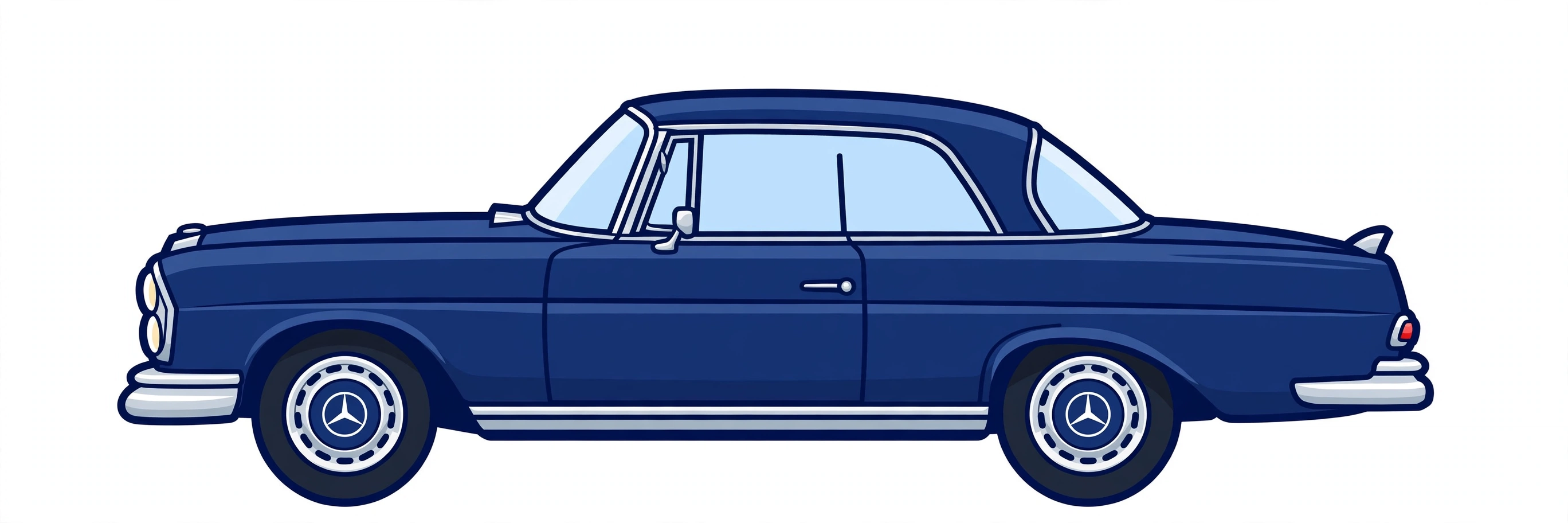
Mercedes-Benz W186 buyer's guide
The 300 'Adenauer' — the chancellor's car, and the top Mercedes of the 1950s.
Years: 1951–1957 · Models: 300, 300b, 300c (the 'Adenauer'), including the Cabriolet D
Overview
The 300 was the flagship with which Mercedes-Benz re-established itself after the war — the car Konrad Adenauer used, and so the car his name attached to. It combined a separate chassis, an overhead-cam 3.0-litre six, and formal coachwork in sedan and rare Cabriolet D forms. Roughly 12,000 sedans were built across the 300, 300b, and 300c; the cabriolets number in the hundreds.
Engines
The 3.0-litre M186 overhead-cam six with twin Solex carburettors, in increasing states of tune across the three series; the last cars offered an optional automatic gearbox.
What to check
- Engine condition and history: M186 parts are expensive, and a rebuild is a major undertaking — compression, oil pressure, and consumption should be verified, not assumed.
- Chassis and body rust, and the condition of the vast amount of chrome, whose replating alone is a five-figure decision on a tired car.
- Completeness of the formal interior — division window, curtains, and fittings on cars so equipped.
- The twin Solexes' tune and the cooling system, which is marginal in modern traffic if neglected.
- Documentation: identity and provenance carry real weight in this small market.
Values
The Cabriolet D is a genuinely rare and valuable car; sedans are bought by marque loyalists at far lower prices. Across the series, documented originality outbids cosmetic restoration, because so much of a 300's worth is in details that cannot be recreated economically.
Buying tips
Have the engine assessed by someone who knows the M186 before purchase, and price any chrome or interior work with real quotes in hand. A 300 is a commitment; the right car is the complete one with paperwork.
See the 17 W186 cars currently listed.