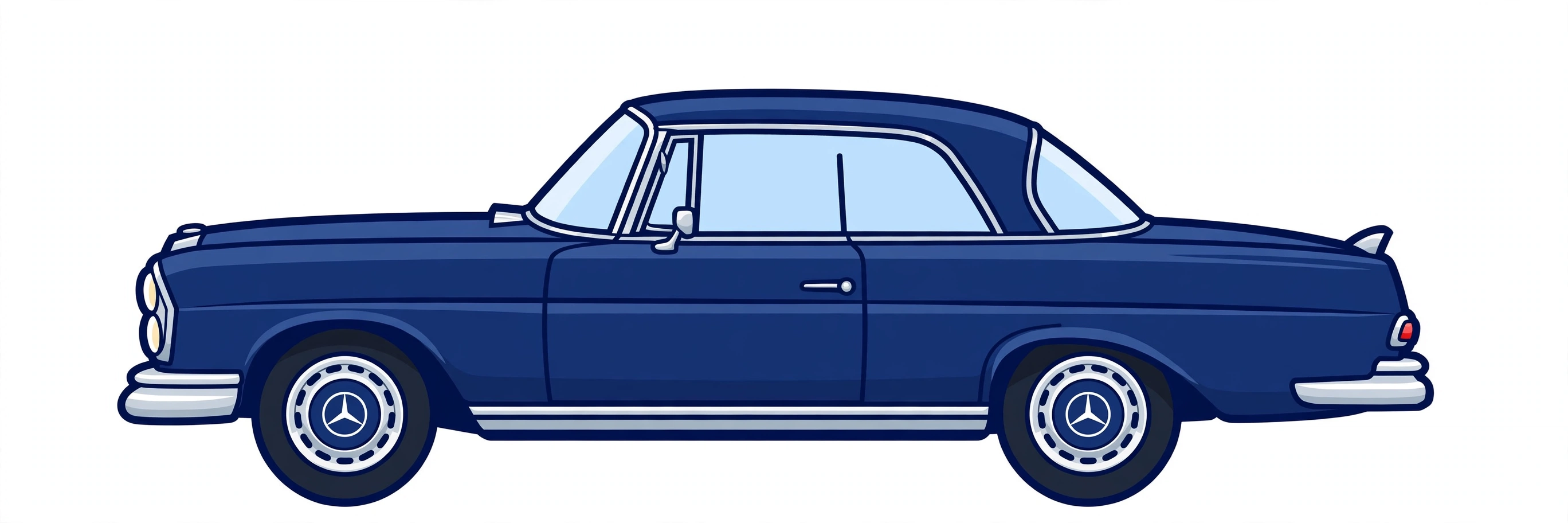
Mercedes-Benz W180 buyer's guide
The big six-cylinder Ponton — the 220S in sedan, coupe, and cabriolet forms.
Years: 1954–1959 · Models: 220a, 220S (Ponton)
Overview
The W180 was the six-cylinder Ponton: the 220a of 1954 and the twin-carburettor 220S from 1956, sold as a sedan and as low-production coupes and cabriolets that are now the series' prize. It established the post-war pattern of a unit body, a subframe-mounted front end, and an overhead-cam six — the mechanical recipe Mercedes used for two decades.
Engines
The 2.2-litre M180 overhead-cam six: single carburettor and about 85 horsepower in the 220a, twin carburettors and about 100–106 in the 220S.
What to check
- Unit-body rust in the floors, sills, and jacking points, and the front subframe's mounting areas — the Ponton family's structural checklist.
- King-pin and steering wear, and brake condition; the newest W180 is more than sixty-five years old, so perished rubber is a given to budget for.
- Twin-carburettor tune on the 220S: uneven idling is usually linkage and balance, not engine wear.
- On coupes and cabriolets, the wood and chrome and the cabriolet's top — where the restoration money concentrates.
- Interior originality: correct fabrics and leathers are a large part of a top car's appeal and are not cheap to recreate.
Values
The 220S coupe and cabriolet are valuable cars; the sedans remain comparatively affordable drivers. For the two-door cars, originality and matching numbers verified by the data card set the price, exactly as with the later W111 coupes they led to.
Buying tips
Approach a W180 as a Ponton first: body structure, then mechanics, then trim. The sedans make charming, usable classics at sensible prices — buy the driest, most original one you can find.
See the 17 W180 cars currently listed.